
What is the Best Age For Kids to Memorise the Quran Fast
The Prophet Muhammad (PBUH) said: “Teach your children to pray when they are seven years old.” This wisdom points to a deeper truth childhood is the ideal time to build Islamic habits and memorization.
From a scientific perspective, children between the ages of 4 and up to so on and have peak memory absorption. Their brains are still developing, making them naturally better at storing new information especially when it involves repetition, rhythm, and sound. The Arabic language of the Quran, with its beautiful rhymes and patterns, is perfectly suited to this stage of development.
Starting early also means:
- Less mental clutter compared to teenagers and adults
- Stronger long-term retention
- More time to complete the full Quran before adulthood
- Building a lifelong relationship with the Quran from a young age
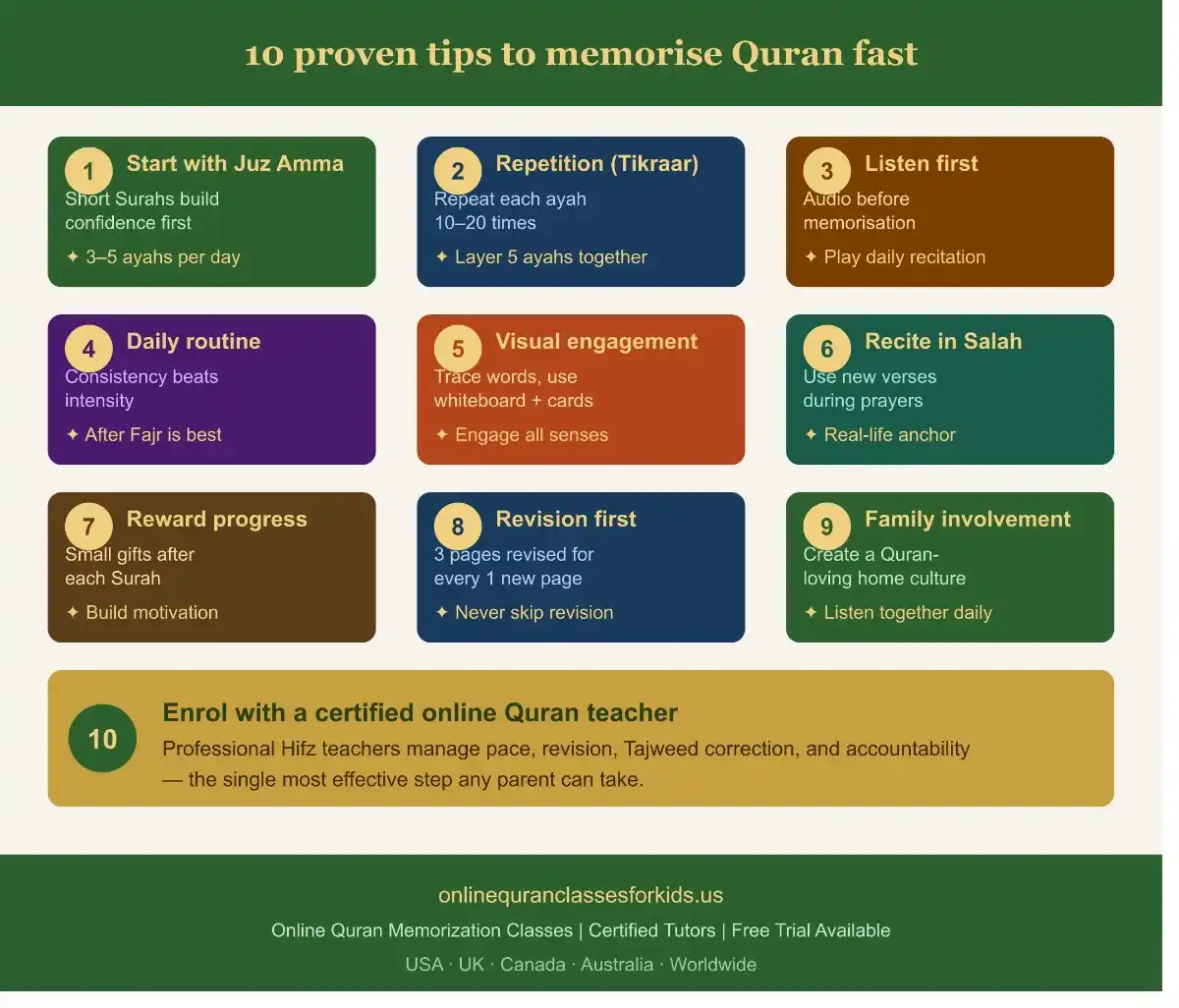
10 Proven Tips to Help Kids Memorise the Quran Fast.
By follow these below 10 tips which are result oriented tips
1. Start with Short Surahs from Juz Amma
The last Juz (30th para) of the Quran contains the shortest Surahs and is the perfect starting point for young learners. Surahs like Al-Fatiha, Al-Ikhlas, Al-Falaq, An-Nas, Al-Kawthar, and Al-Asr are short, rhythmic, and easy to memorize.
Completing small Surahs builds confidence and motivates children to continue. Never start a beginner child with long Surahs it creates discouragement.
Tip: Begin with 3–5 ayahs per day, not more.
2. Use the Repetition Method (Tikraar)
Repetition is the foundation of Quran memorization. The Arabic word Tikraar means to repeat, and this is exactly how Hifz works. Scholars recommend the following technique:
- Recite one new ayah 10–20 times before moving to the next
- After memorizing 5 ayahs, recite all 5 together repeatedly
- The next day, revise what was learned before adding new ayahs
This layered repetition ensures the verses are stored in long-term memory, not just short-term recall.
3. Listen Before Memorising (Audio-First Method)
Children learn language through hearing. Before asking your child to memorise any verse, let them listen to it multiple times from a qualified reciter. Apps, YouTube Qaris, and certified online tutors can all help with this.
Recommended reciters for children:
- Sheikh Abdul Basit Abdul Samad
- Sheikh Mishary Al-Afasy
- Sheikh Sudais (slow recitation versions)
When a child hears the verse dozens of times before memorizing it, the brain starts processing it automatically making memorization much faster.
4. Create a Consistent Daily Routine
Consistency is more important than intensity. Memorizing 5 minutes every day is far more effective than memorizing for 2 hours once a week.
Set a fixed memorization time each day:
- After Fajr prayer is the most recommended time the mind is fresh and the environment is quiet
- After school, during a calm period
- Before bed (the brain consolidates memory during sleep)
Make it a non-negotiable part of the daily routine, just like eating or brushing teeth.
5. Use Visual and Physical Engagement
Children are kinesthetic learners they learn better when their body is involved. Use these techniques:
- Trace the words with a finger while reciting
- Use a whiteboard and write the ayah, then erase it word by word as it’s memorized
- Colour-coded Quran copies designed for kids work very well
- Flashcard systems with one ayah per card
Engaging multiple senses (sight, touch, hearing, speaking) speeds up memorization dramatically for children.
6. Recite During Daily Prayers (Salah)
This is one of the most powerful and underused tools. When a child uses newly memorized Surahs or ayahs during their Salah, it reinforces memory through real-life application.
Encourage your child to recite new memorizations during Fajr and Maghrib prayers specifically. The emotional and spiritual context of Salah creates a stronger memory anchor.
7. Set Small Goals and Reward Progress
Children respond extremely well to positive reinforcement. Set achievable weekly goals and celebrate when they are reached.
Ideas for rewards:
- A small gift or favourite meal after completing a Surah
- A star chart on the wall for each page memorized
- Family celebrations when a Juz is completed
- A special outing after finishing 5 Juz
This builds internal motivation over time. The goal is for your child to associate Quran memorization with joy, not stress.
8. Revision is More Important Than New Memorization
Many parents make the mistake of only focusing on new memorization without adequate revision. In Hifz, this leads to forgetting older verses as new ones are added.
Follow the 3:1 revision rule:
- For every 1 new page memorized, revise 3 older pages
A qualified Quran teacher will structure this properly. Online Hifz programs like those offered at Online Quran Classes for Kids Quran Academy build structured revision schedules so no portion is ever forgotten.
9. Involve the Whole Family
Children thrive in an environment where Quran is part of the family culture. When parents, siblings, and the home environment all reflect love for the Quran, a child is naturally more motivated.
Practical ideas:
- Have family Quran recitation sessions in the evenings
- Play Quran recitation as background audio in the home
- Share stories of the Sahabah who memorized the Quran
- Let the child “teach” a younger sibling what they’ve memorized — teaching reinforces memory
10. Enrol in Online Quran Memorization Classes with a Certified Teacher
The single most effective step any parent can take is to enrol their child with a qualified, experienced Quran teacher someone trained specifically in Hifz methodology.
A professional teacher will:
- Correct Tajweed errors before they become habits
- Manage the pace of new memorization based on the child’s ability
- Structure revision cycles properly
- Keep children accountable and motivated
- Provide feedback that parents at home simply cannot